
核心技术Core Technology
提箭回收Lift recovery
高可靠 · 深复用 · 全场景。把着陆载荷从箭体底部搬到顶部,火箭就不再需要一整套地面回收设施。Reliable, deeply reusable, site-agnostic. Move the landing load from the bottom of the airframe to the top, and the rocket stops needing a ground recovery complex.
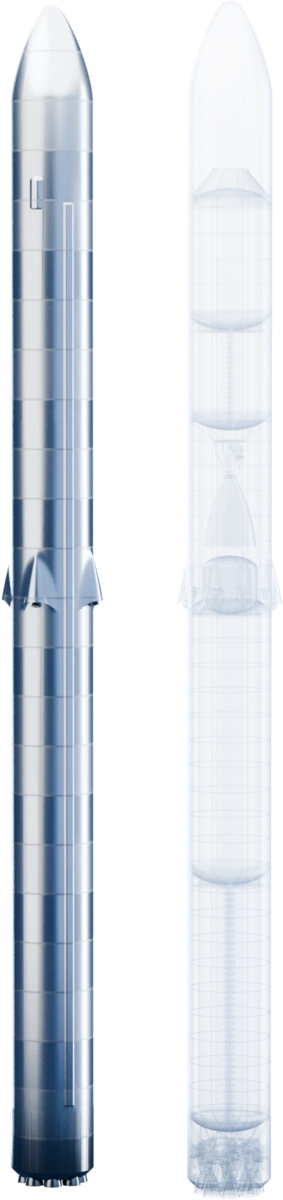
全长 47.9 m · 直径 3.35 m · 起飞 227 t · 一级 9 × 30 t47.9 m tall · 3.35 m diameter · 227 t liftoff · 9 × 30 t first stage
整箭构型Vehicle Layout
提箭式运载火箭The lift-recovery launch vehicle

左右拖动可转动箭体 · 点标注看该段细节 Drag sideways to turn the vehicle · tap a label to zoom that section
原理Principle
一次返回,两套动力One descent, two propulsion systems
提箭法在火箭各级顶部设置一套副液体动力系统 —— 提箭发动机系统。初始返回阶段由底部主动力系统完成主要减速任务,提箭发动机系统配合完成箭体姿态的初步修正;进入近地阶段后,改由提箭发动机系统承担箭体空重,完成最终着陆。Lift recovery puts a secondary liquid propulsion system — the lift engine system — at the top of every stage. Through the initial return phase the base engines do the primary braking while the lift engines trim the vehicle's attitude; in the terminal phase the lift engines take over the empty vehicle's weight and fly it to touchdown.
回收发动机远离地面,箭体底部只需简化的裙边结构承重。着陆载荷从底部搬到顶部之后,大型地面辅助回收装置就不再是必需品,落地即在工位 —— 复用周期从「回收 — 转运 — 检修」压缩成「就地检修」。With the recovery engines far from the ground, the base of the airframe only needs a simplified load-bearing skirt. Once the landing load moves to the top, large ground recovery equipment stops being a prerequisite: the vehicle lands where it will be serviced, and the reuse cycle collapses from recover–transport–inspect down to inspect in place.
返回段Descent Sequence
三个阶段Three phases
- 白色尾焰 —— 底部主动力White plume — base main engines
- 蓝色尾焰 —— 顶部提箭发动机Blue plume — top-mounted lift engines
对照Comparison
底部反推 与 提箭法Base retro-thrust vs. lift recovery
| 维度Dimension | 底部反推回收Base retro-thrust | 提箭法回收Lift recovery |
|---|---|---|
| 着陆承载Landing load path | 底部发动机反推顶住箭体Base engines push the airframe up | 顶部提箭发动机承担空重Top lift engines carry the empty mass |
| 姿态修正Attitude control | 推力作用点在质心之下Thrust applied below the centre of mass | 推力在质心之上,力矩更大、响应更快Thrust above it — larger moment, faster response |
| 地面设施Ground infrastructure | 需要大型地面辅助回收设备Large ground recovery equipment required | 箭体自搬运,底部简化裙边承重Self-transporting, simplified load-bearing skirt |
| 复用周转Turnaround | 发射后维护时间长Long post-flight servicing | 返场回收快速复用,任务间隔短Quick reuse on return, short mission interval |
| 适用环境Environment | 依赖大气与地面条件Depends on atmosphere and prepared ground | 不依赖空气动力,地球与地外通用No aerodynamics needed — Earth and beyond |
收益What It Buys
更高效 · 更经济 · 更通用More efficient, cheaper, more universal
-
01
更高效More efficient
着陆姿态修正响应更迅速 —— 力矩更大。回收动力位于箭体顶部,离质心更远,同样的推力能产生更大的控制力矩,着陆段的姿态修正更快收敛。Attitude corrections respond faster, because the moment arm is longer. With the recovery engines at the top of the airframe, further from the centre of mass, the same thrust produces a larger control moment and the terminal phase settles sooner.
-
02
更经济More economical
无需大型地面辅助回收装置 —— 静稳定特性。推力作用点在质心之上,箭体在下降段呈静稳定悬挂状态,地面不必为每个着陆点重复建设重型资产。No large ground recovery equipment is required, thanks to static stability. With thrust applied above the centre of mass the vehicle hangs in a statically stable state on descent, so heavy assets need not be rebuilt at every landing point.
-
03
更通用More universal
适用地外行星回收场景 —— 不依赖空气动力。全程不借助大气产生的气动力与地面辅助设施,月球、火星这类无大气或稀薄大气环境同样适用。It works for recovery on other planets, because it never relies on aerodynamics. No atmospheric lift or drag and no ground support are needed, so airless and thin-atmosphere environments such as the Moon and Mars are equally in scope.
出发点Starting Point
三个痛点,三条解法Three pain points, three answers
行业痛点很清楚:太空运输成本高、效率低,航班化尚未实现。三条症结都指向同一个地方 —— 地面。The industry's problem is not subtle: space transport is expensive, slow, and nothing like an airline yet. All three symptoms trace back to the same place — the ground.
-
地面设备冗余Redundant ground equipment
- 痛点Pain point
- 传统回收方式需要大型地面辅助回收设备,导致重型资产冗余。Conventional recovery needs large ground support equipment, so heavy assets pile up unused.
- 精简投入Trim the investment
- 回收发动机远离地面,箭体底部简化裙边结构承重。The recovery engines sit far from the ground and the base of the airframe carries load through a simplified skirt.
-
周转效率低Slow turnaround
- 痛点Pain point
- 发射后维护时间长,难以实现航班化连续运营。Post-flight servicing takes so long that continuous, airline-style operation is out of reach.
- 快速周转Fast turnaround
- 箭体自搬运,返场回收快速复用,显著缩短任务间隔。The airframe transports itself, comes back for quick reuse, and cuts the gap between missions sharply.
-
回收条件需求高Demanding recovery conditions
- 痛点Pain point
- 传统回收方式依赖大气、地面,难以满足多场景运载需求。Conventional recovery leans on the atmosphere and on prepared ground, which rules out most mission scenarios.
- 行星通用Any planet
- 广泛适应地球、地外(月球、火星)的发射与着陆。One method covers launch and landing on Earth and beyond — the Moon and Mars included.
- 高频运营High cadence 快速复用运载平台,大幅缩短任务间隔,实现航班化发射。A rapidly reusable platform that shortens the interval between missions enough to launch on a schedule.
- 低成本运营Low operating cost 提升复用效率,降低单次运输成本,推动商业化普及。Better reuse efficiency drives down the cost of a single flight and makes commercial use ordinary.
- 全场景运输Every mission type 支持载人、货运、应急及深空运输,构建常态化太空交通体系。Crew, cargo, emergency response and deep space — the basis of routine traffic to orbit.
这三条是航班化太空通勤平台必须同步满足的核心需求。提箭回收方案的完整表述则是 高可靠 + 深复用 + 全场景。An airline-grade space commuting platform has to satisfy all three at once. Stated in full, lift recovery means high reliability, deep reuse, any site.